Applied research areas

Collaboration with Huawei - System design (PHY and MAC) of cognitive radio systems and standardization of IEEE 802.22. Generated 15 patents and standard contributions and 4 of them have been adopted into IEEE 802.22.
Cognitive Radio system research (ieee 802.22)
Collaboration with Huawei - System design (PHY and MAC) and standardization of the next generation WiMAX (IEEE 802.16m). Generated 14 patents and standard contributions.
next generation wimax (IEEE 802.16m)
System design (PHY, MAC, Architecture and RRM) and standardization of the 5G systems with focus on new architecture and the associated RRM techniques.
Green Wireless Networks for 5G Systems
Collaboration with ASTRI - Signal processing design for practical MIMO detection, precoding and mode adaptation algorithms with applications in WiFi - 802.11n.
practical mimo algorithm design for WiFi - IEEE 802.11n
Collaboration with ASTRI - ASIC architecture design and complexity analysis for reconfiguration baseband ASIC design that supports both WiMAX (802.16e) and WiFi (802.11n)
reconfigurable ASIC architecture design for wimax (IEEE 802.16) and WiFi - IEEE 802.11n
High capacity and extended coverage wifi Access point infrastructure design
As the chief architect (and later technology advisor) for ASTRI wireless access team (later spinned off to be Altai Technologies) - Architecture design and implementation of a novel WiFi infrastructure that provide extended coverage and high capacity for Wi-Fi Cellular applications. The core technology involves system algorithm (MAC) and the smart antennas (beam-forming). The design (A8) has obtained a lot of awards (such as the Innovation and Technology Award 2007) and is currently a product selling in overseas market.
WCDMA (UMTS) Base station ASIC
(Bell-Labs) - Algorithm design and ASIC Tier 0, Tier 1 architecture design for a UMTS base station ASIC (called “OneChip”). The ASIC can accommodate 64 voice users and HSDPA.
ITF supported project - Single chip CMOS ASIC design of RFID reader and tag. Algorithm design, ASIC architecture and tape-out.
ASIC design of RFID Passive reader and Tag
HIA supported project - Algorithm design and ASIC architecture design of UWB system, capable of delivering 480Mbps bit rate.
baseband ASIC design of UWB (MB-OFDM) system
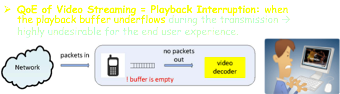
Typical radio resource management attempts to maximize the PHY performance regardless of the applications. The wireless communication network is to provide a transparent pipe without worrying about what specific application is using the pipe. This sometimes results in suboptimal designs for some niche applications. Video streaming is one of the critical applications that drive the capacity demand of future 5G wireless networks. To support video streaming, it is not just about higher bit rate but QoE-aware radio resource management is the key. This is a collaboration project with a key industrial player to define next generation QoE-aware cross layer radio resource management for video streaming, targeting at driving the future LTE standards.
QoE-Aware Video Streaming for 5G Wireless Systems (2015 -- 2017)
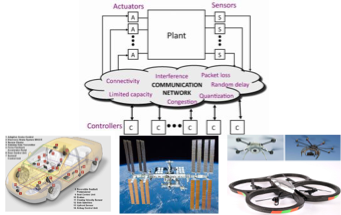
Typical radio resource management attempts to maximize the PHY performance regardless of the applications. The wireless communication network is to provide a transparent pipe without worrying about what specific application is using the pipe. This sometimes results in suboptimal designs for some niche applications. In Machine-to-Machine Communications, the target application is not about content delivery but rather trying to form closed-loop feedback to stabilize a potentially unstable dynamic system such as a big industrial plant. In this project, we target at designing “application-specific” radio resource optimization algorithms to reduce the wireless resource needed for the stabilization task. This is highly non-trivial as it involves the interplay between control theory and communication theory. This is a collaboration project with a leading industrial player and we aim to drive the future LTE standards in M2M communications.
Wireless Resource Management for Machine-to-machine Networked COnTrol Applications (2015 -- 2017)
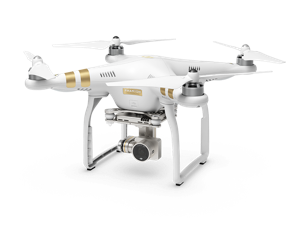
UAV is a very hot research topic with widespread applications. In particular, the concept of flying camera is very popular. One limitation of existing platform is the wireless video link between the UAV and the ground controller. In this project, we apply advanced wireless communication designs to extend the range and improve the bit rates of the wireless video link over the UAV applications. We will investigate if the bottleneck of the UAV-link is due to the link budget (and channel fading) or due to the interference in the ISM spectrum. Based on the analysis, we will apply innovative solutions to address the fading and the interference issues. This is a collaboration project with DJI, a start up company by HKUST alumni.
Robust Wireless Video Link for UAV applications (2015 -- )
In future 5G wireless communications, there are challenging demand in terms of 1000X higher capacity, 1000X higher connectivity and 100X lower latency to support advanced and new applications. One key enabling technology is called “massive MIMO” in which the base station is equipped with hundreds of antennas. With massively increased number of antennas, it brings huge opportunities in terms of higher spatial multiplexing freedom as well as higher capability to mitigate interference in the cellular networks. However, there are also plenty of challenges. In this project, we explore practical designs and algorithms to support hybrid beam-forming solution in massive MIMO. This is a collaboration project with a key industrial player.
Robust Hybrid beamforming in Massive MIMO for 5G Wireless Communications (2015 -- 2016)
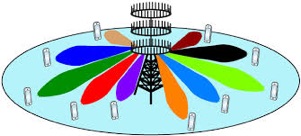
In this project, we develop a robot-assisted autonomous channel measurement platform. The platform consists of a mobile robot, a wireless transceiver and an embedded controller. The embedded controller will run several key algorithms such as Simultaneous Localization and Mapping (SLAM), wireless coverage mapping, and channel-driven path planning for the robot to complete the channel measurement path with minimum power and number of measurement samples.
Robot-Assisted Channel characterization platform development (2015--2017)