◆ FAQ for PhD Students

Why did I study for a PhD?
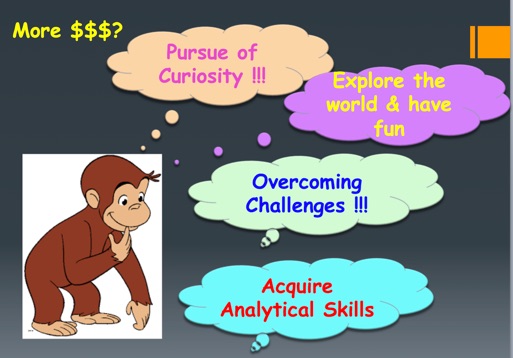
“I worked in the industry for 3 years after my Bachelor. Life then was very good — colorful life and good salary. Yet, after working for 3 years, I felt it's time to pursue my curiosity in communications. Most advice I got was ‘You must be crazy... Can you really find a job after getting a PhD?’ At the end, I asked myself ‘Will you be starved to death after returning from PhD?’ and I answered ‘Probably not.’ Based on that, I quit my job and started this long journey of research career.”
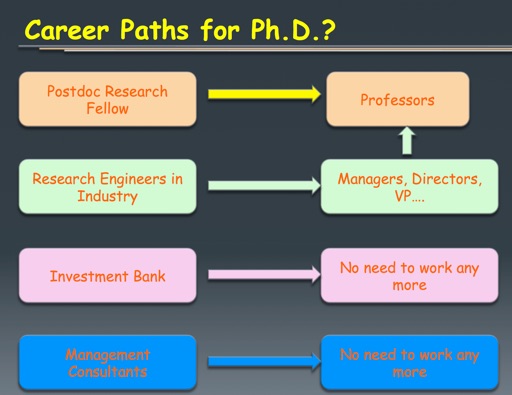
What can you do after getting a PhD?
The answer really depends on how you do your PhD.
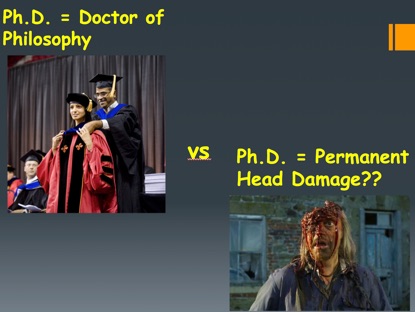
What is PhD Study Like?
Doing a PhD is like playing a “survivor game” in a jungle of knowledge. It is YOU to play the game (not the supervisor). During the process, you will feel lost all the time and yet, you have to use your wisdom to explore your way out. You also have to sharpen your tools from time to time or else you will be killed by some beasts or miss some good opportunities. The supervisor might occasionally point you in some direction or give you some advice, but it's YOU to explore and struggle your way out. Some will enjoy it because it's like a challenge to yourself — just like people like to run marathons.
My Goals for PhD Students
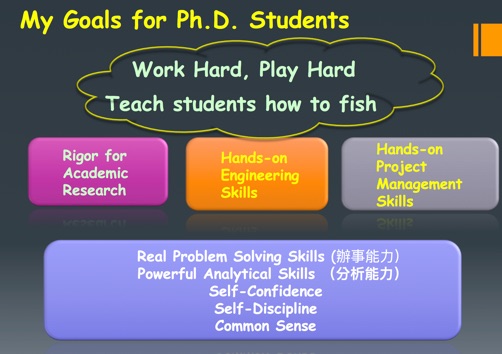
Do you consider getting a PhD as a beginning or an end? I believe if one could survive the process, he/she will have strong analytical skills and problem-solving skills. Most importantly, he/she will have “magical” self-confidence to get things done even though they have never tried that before. These attributes will be very important assets in your future career no matter what career path you choose.
Recommended Courses for PhD Students in My Team
- MATH 3033 — Real Analysis
- ELEC 5470 — Convex Optimization (Fall)
- ELEC 5460 — Stochastic Optimization with Applications to Wireless Systems and Machine Learning (Fall)
- MATH 5411 — Advanced Probability Theory I (Fall)
- MATH 5412 — Advanced Probability Theory II (Spring)
- MATH 5470 — Statistical Machine Learning
My Requirements for PhD Students
1) Excellent Ability of Comprehension of New Knowledge: You need to grasp new knowledge or understand a paper quickly. The ability to self-study effectively is critical. This is usually reflected by good GPA in UG studies.
2) Excellent Ability of Asking Questions: A fundamental but critical requirement. Research is about finding answers, but before you can create new knowledge, you must recognize “what's wrong with the existing results.” Your ability to discover problems is tightly related to your way of thinking — this is so fundamental that you cannot get this ability overnight if you do not have it. (e.g. Do you get used to asking questions during class?)
3) Excellent Ability of Communications: Can you explain your ideas clearly? Ideas have to be matched with words to form statements before they have the qualification to be called “right” or “wrong”. I like students who can give me (a) technical confidence (安全感) — the results generated are correct — and (b) efficient “top-down” communications — I can grasp the top-level logic quickly without diving into unnecessary low-level details.
How to Ask Questions Properly
Bad questions:
“Prof, I cannot solve this equation... what should I do?”
“Prof, I got stuck with this optimization problem, what should I do?”
These reflect the student is not independent. It is not possible for the supervisor to give an answer without jumping into the same level of details as you, which defeats the setting that the PhD student is the “owner” of the problem.
Good questions:
“Prof, I got stuck with this optimization problem. It's too complicated. I suspect there is some problem with the original formulation. In fact, we could have the following simplifications if we look at these asymptotic cases… what do you think?”
Scenario #2 (my expectation): The discussion should be like playing badminton or ping-pong. If there is “back and forth,” it is interesting. The process is ridiculously boring if the ball is always dropped on the ground after one or two strokes.